
Insurance Company Shortlist
Compare Insurance Companies by ZIP Code
Compare insurance companies by ZIP Code using a shortlist method instead of opening random quote pages. The goal is to find 3–5 strong providers in your area, score them by price, coverage, discounts, and claim-time risk, then choose the company that gives the best total value. See the main reasons quotes vary by company.
A company can look cheaper at first but still lose on coverage clarity, deductible exposure, or missing discounts. Use this page as a decision hub: build a shortlist, compare provider pages, and rank each company before choosing.
Get Insurance Quotes by ZIP Code
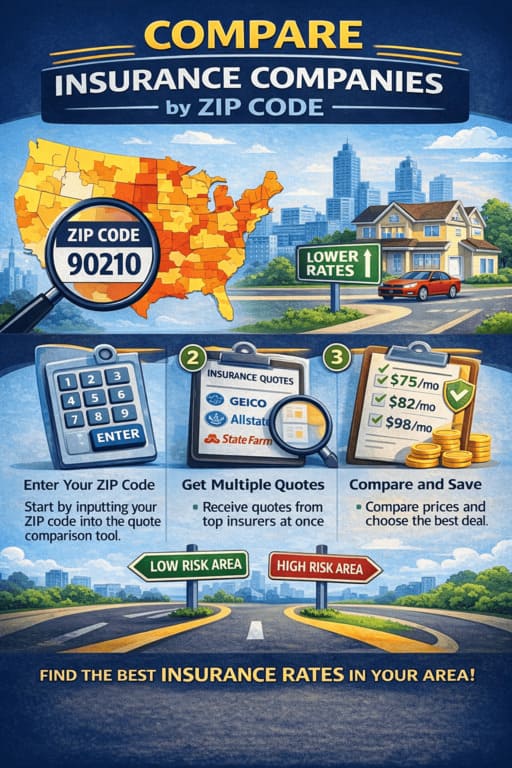
Start with your ZIP Code, then compare companies using the same basic profile. After you collect quotes, use the scorecard below to rank providers instead of choosing only by the lowest first price.
Use the same limits and deductibles on every quote; the forms continue to a partner site, not to an insurance company.
Auto Insurance Quote
Compare auto companies by ZIP Code, driver profile, vehicle details, and coverage strength.
Home Insurance Quote
Compare home insurance companies by ZIP Code, dwelling coverage, deductible, and discounts.
How to Build a Shortlist of Insurance Companies
Instead of opening every company page at once, build a shortlist of three providers first: one company that may be strong on price, one that may offer broader coverage options, and one that may fit your specific situation such as bundling, high-risk auto, new homeowners, or a clean driving record.
The same shortlist works beyond auto and home. For a life insurance quote, keep the death benefit, term length and riders identical across every company.
A useful rule is the “3-company screen”: compare 3 providers, 3 coverage categories, and 3 final numbers. For auto, check liability, physical damage coverage, and deductible. For home, check dwelling coverage, personal property, and liability. Then compare monthly payment, annual premium, and claim-time deductible exposure.
If you are considering a multi-policy setup, review bundled auto and home insurance quotes as a separate path before deciding whether one company should handle both policies.
Company Shortlist Scorecard
Use this scorecard to rank each company before you choose. Give each category a simple 1–5 score, then compare the total. A company with a slightly higher premium may still win if it has clearer coverage, better add-ons, or lower claim-time risk.
Insurance Company Scorecard
This table makes the page different from a basic quote comparison. Instead of only asking “which company is cheapest,” it helps you ask “which company is strongest for my ZIP Code and policy needs?”
Ranges and dollar figures in this table are illustrative examples, not quotes or market averages. Actual changes vary by insurer, state and your driver or home profile.
| Score Area | What to Check | 1-Point Warning Sign | 5-Point Signal |
|---|---|---|---|
| Price stability | Monthly payment and annual premium | Low first quote but unclear final fees | Clear annual cost with stable inputs |
| Coverage clarity | Limits, deductibles, exclusions | Hard to tell what changed | Easy side-by-side coverage summary |
| Discount depth | Bundle, safe driver, claim-free, security | Discounts mentioned but not shown | Discounts itemized clearly |
| Claim-time risk | Deductible and out-of-pocket exposure | Premium drops because deductible jumps | Savings without uncomfortable claim cost |
| Fit by situation | Homeowner, renter, driver profile, ZIP risk | Generic quote with few options | Policy fits your actual household |
Compare Value, Not Just the First Price
A company that saves $12 per month saves $144 per year. That can be useful, but not if the quote also raises your deductible by $500 or removes a coverage you would actually use. The better question is whether the yearly savings are large enough to justify the extra claim-time risk.
For example, if Company A costs $1,280 per year with a $500 deductible and Company B costs $1,150 per year with a $1,000 deductible, Company B saves $130 annually but increases claim-time exposure by $500. That may still be worth it for some shoppers, but it should be a deliberate choice.
For a provider-style reference focused on Esurance-related quote shopping, review Esurance insurance quotes and coverage comparison while keeping your scorecard method in mind.
Provider Pages to Use as Comparison Samples
Use provider pages as samples, not as a reason to choose by brand alone. Read them with the same scorecard: price clarity, coverage details, discount visibility, deductible exposure, and fit for your situation. Each carrier guide here is checked against the carrier's own pages and public regulator sources; see how we research carriers.
Start with Progressive insurance quote comparison if you want one example of a carrier-style auto quote page. Then compare the same type of information against other company pages instead of jumping straight to the lowest number. Regional non-standard carriers are worth a look too, such as GAINSCO auto insurance quotes.
If the driver profile is more complex, you can also review The General insurance quotes for drivers and decide whether that type of provider belongs in your shortlist.
When to Add More Companies to the List
Add more companies only when your first 3–5 options do not produce a strong fit. Signs that you should expand the list: all quotes are far above your budget, every quote requires an uncomfortable deductible, or none of the companies offers the specific coverage feature you need.
A practical expansion rule is simple: add 2 more companies at a time, not 10. Compare them against your current best option using the same scorecard. This keeps the process organized and prevents quote fatigue.
For another internal provider page, review Esurance insurance quotes by ZIP Code and compare it against the external Esurance-focused resource only after your scoring categories are clear.
How to Use Auto and Home Pages With This Company Hub
This page works best as a hub for choosing companies. Use auto and home pages for quote entry, then return here to rank the companies. That gives the site a clearer structure: quote pages collect offers, while this page helps with the final company decision.
For broader quote workflows, review auto insurance quotes by ZIP Code and home insurance quotes by ZIP Code before checking company-specific pages.
Final Shortlist: Pick the Best 2 Companies
After the first comparison, choose your best two companies and review them more carefully. Look at the annual cost, deductible exposure, coverage summary, discount list, and whether each company actually fits your household. Use the car insurance quote checklist so every finalist uses the same inputs, and how to switch car insurance if you are moving mid-term or at renewal.
You can use Geico insurance quotes online and State Farm auto insurance quotes online as additional reference points when building your final shortlist.
The best company is not always the cheapest company. It is the one with the best combined score for your ZIP Code, coverage needs, claim-time comfort, and total annual cost.
Frequently Asked Questions
These questions cover how to compare companies in your area, how many to include, claims handling, and where to check complaints.
How do I compare insurance companies in my area?
Start with your ZIP code and build a shortlist of three to five insurers that sell in your state. Request quotes with the same coverage, then compare price, deductibles, discounts, claims service and financial strength. Check your state insurance department or the NAIC complaint data before choosing the final company.
How many insurance companies should I compare?
Comparing three to five companies usually gives a clear picture of the price range in your ZIP code without becoming overwhelming. Include at least one large national insurer, one regional or local company and, if relevant, an insurer that specializes in your situation, such as high-risk drivers or older homes.
Are cheaper insurance companies worse at handling claims?
Not necessarily. A lower price can reflect different underwriting, fewer agents or a narrower product range rather than poor service. Check complaint records with the NAIC or your state insurance department, read the policy's claims terms and confirm financial strength ratings before deciding that a cheaper insurer is a risk.
Where can I check an insurance company's complaints and ratings?
The NAIC Consumer Insurance Search tool shows complaint data for insurers, and your state insurance department can confirm a company is licensed. Financial strength ratings come from agencies such as AM Best. Use these sources together with quotes, because a low price matters only if the company pays claims reliably.