
Multi-Policy Insurance Savings
Bundled Auto and Home Insurance Quotes
Bundled auto and home insurance quotes are easiest to compare when both policies stay consistent from the start. A lower bundle price is useful only when auto limits, home coverage, deductibles, and add-ons still match what you would actually keep. For a rough number first, try the home insurance cost calculator.
Start with one clean ZIP-based baseline for both policies, then compare bundled offers using the same protection levels. After that, test one change at a time so you can tell whether the savings come from a real bundle discount or from reduced coverage.
Get Bundled Auto and Home Insurance Quotes by ZIP Code
Enter your ZIP Code to start separate auto and home quote baselines. For a fair bundle comparison, keep the same drivers, vehicles, dwelling details, coverage limits, and deductibles first.
Use the same limits and deductibles on every quote; the forms continue to a partner site, not to an insurance company.
Auto Insurance Quote
Start with your auto baseline first, then keep the same limits and deductibles when comparing bundles.
Home Insurance Quote
Use the same ZIP Code and consistent home coverage settings to compare bundle savings accurately.
How Bundled Auto and Home Insurance Quotes Work
Bundling usually means placing your auto and home insurance with the same carrier to qualify for a multi-policy discount. It can simplify billing and sometimes reduce the total premium, but the best bundled quote is not always the one with the lowest number on the screen. Carriers that bundle include The Hartford; see The Hartford bundle quotes.
The real value comes from a bundle that keeps solid protection on both policies while still delivering meaningful savings. Compare auto liability limits, collision and comprehensive deductibles, dwelling coverage, personal property, liability, and home deductibles side by side.
For a broader bundle explanation, review our sister site's home and auto guide. It fits well when you want to compare combined coverage instead of judging each policy alone.
Many shoppers first compare the discount percentage, but the smarter metric is the total annual cost after coverage is matched. For example, a 12% bundle discount on two policies costing $2,400 per year saves about $288 annually, while a 20% discount would save about $480. However, if the cheaper bundle also raises the auto deductible from $500 to $1,000 or increases the home deductible from $1,000 to $2,500, the lower premium may come with significantly higher claim-time risk.
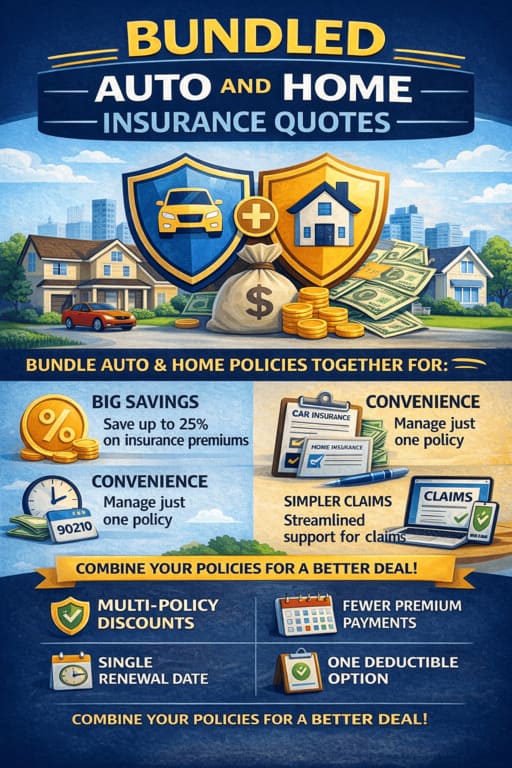
Useful Numbers Before You Choose a Bundle
These numbers are not guarantees, but they help you spot whether a bundle is worth a closer look. Always compare the discount together with the final coverage quality.
Bundle Comparison Checklist
Use this table to keep your bundle comparison honest. If one bundle changes coverage while another does not, the comparison becomes misleading.
If you want to compare how one large carrier structures online quote inputs, review Progressive insurance quote options and use the same baseline method when checking bundle pricing.
Ranges and dollar figures in this table are illustrative examples, not quotes or market averages. Actual changes vary by insurer, state and your driver or home profile.
| Bundle Factor | What to Compare | Why It Matters | Quick Tip |
|---|---|---|---|
| Auto liability limits | Same bodily injury and property damage limits | Different limits can make one bundle look falsely cheaper. | Match limits before comparing total cost. |
| Auto deductibles | Collision and comprehensive deductibles | Higher deductibles lower premium but increase claim cost. | Test $500 vs $1,000 only after the baseline. |
| Home coverage amounts | Dwelling, personal property, and liability limits | Lower home limits can hide weak protection inside a cheap bundle. | Compare replacement-oriented settings, not just price. |
| Home deductible | Flat deductible and special deductibles if shown | Deductible changes can move the total price significantly. | Keep the same deductible first, then test savings. |
| Bundle discount vs total value | Discount amount plus final coverage quality | Big discount does not always mean best policy value. | Judge the bundle by total cost and coverage together. |
How to Compare Bundle Quotes Without Mistakes
The easiest way to compare bundle offers is a two-step method. First, create one baseline quote for both auto and home policies using the coverage you would actually keep. Second, compare bundle quotes from multiple carriers using that same setup before changing any options.
This removes the most common error in online insurance shopping: comparing prices from different coverage configurations and assuming the lowest price is automatically the best value.
For a broader starting point, review car insurance quotes by ZIP Code and home insurance quotes by ZIP Code before finalizing a bundle decision.
Start With a Baseline for Both Policies
For auto insurance, keep the same drivers, vehicle use, annual mileage, liability limits, and deductibles. For home insurance, keep the same dwelling amount, personal property limits, liability limits, and deductible. This gives you a clean starting point to compare bundled offers fairly.
Once you know the baseline price range, test one change at a time. Raise or lower a deductible, add roadside assistance, include water backup, or compare pay-in-full pricing separately. This helps you see exactly what affects the premium most.
For another brand-level reference, check Allstate insurance quotes online and compare the same ZIP Code, coverage limits, deductibles, and optional features before judging the total price.
When a Bundle May Not Be the Best Option
Bundling is often a strong value, but not always. In some cases, one carrier may be competitive for auto while another offers better home coverage or pricing. That is why it helps to compare bundled quotes and standalone auto and home quotes before finalizing a policy.
Watch for bundles where the discount is large but the home deductible jumps, replacement cost coverage changes, or auto add-ons disappear. The goal is not just to get a bundle discount—it is to get the best total value for both policies with coverage you are comfortable keeping.
You can also review Farmers insurance quotes by ZIP Code when you want another provider-style comparison before deciding whether a bundle or separate policies make more sense.
Next Step: Compare Bundled Auto and Home Quotes
Run your ZIP-based auto and home quote baseline, compare bundle offers using the same coverage settings, and then test one change at a time to confirm real savings. This method helps you find a stronger bundle decision without overpaying or accidentally lowering protection.
The best bundle is not simply the lowest monthly payment. It is the setup where the total annual cost, claim-time deductible exposure, liability protection, and home coverage limits all make sense together.
Frequently Asked Questions
These questions cover whether a bundle is cheaper, bundling with different companies, what should match across quotes, and canceling one policy later.
Is it cheaper to bundle home and auto insurance?
Often, but not always. Most insurers offer a multi-policy discount when you combine home and auto, yet a different insurer may still be cheaper for one of the policies. Compare a bundle quote with the best separate quotes using the same coverage, and look at the combined yearly cost, not only the discount.
Can I bundle auto and home insurance with different companies?
A bundle discount usually requires both policies from the same insurer or insurance group, so two unrelated companies will not give you a multi-policy discount. Some insurers partner with other companies for home coverage, which can still count as a bundle. Ask which company issues each policy and how claims are handled.
What should match when comparing bundle quotes?
Keep the same drivers, vehicles, auto liability limits, collision and comprehensive deductibles, dwelling limit, home deductible and endorsements on every bundle quote. Then compare the total yearly cost, the discounts applied and the claims process. Otherwise a lower price may simply reflect weaker coverage rather than a better bundle deal.
Can I cancel one policy in a bundle later?
Yes. You can usually cancel or move one policy, but the multi-policy discount on the remaining policy will likely end, so its price may rise at the next renewal. Before switching only one policy, compare the new combined cost, including the lost discount, with keeping both policies together.